


Big data continues to reshape how organizations operate, compete, and create value. In 2026, the focus has shifted from simply collecting and storing massive volumes of information to making data usable in real time, governed effectively, and ready for advanced artificial intelligence. Enterprises that treat data as a strategic asset—rather than a byproduct of operations—are gaining clearer insights, faster decision-making, and more resilient operations. Key developments include the rise of real-time data streaming, agentic systems that act on data autonomously, platform convergence, stronger privacy and sovereignty requirements, and more intelligent business intelligence tools.
Real-Time Data Streaming Becomes Essential for AI Success
Traditional batch processing often proves too slow for modern demands. Organizations increasingly rely on continuous, event-driven data flows that deliver information as it is generated. Data streaming ranks as a top investment priority for a large majority of IT leaders, enabling faster AI adoption, improved customer experiences, and measurable business outcomes.
This approach supports use cases such as decision intelligence, autonomous operations, and digital twins. Continuous data pipelines allow systems to respond immediately to changes in customer behavior, supply chains, or operational conditions. Companies that overcome challenges around data quality, governance, and infrastructure are unlocking greater value from their AI investments. Real-time capabilities turn static data repositories into living systems that feed accurate, timely inputs to both human decision-makers and automated agents.
Agentic AI and Multi-Agent Systems Transform Data Management
Agentic AI represents one of the most significant shifts in data and analytics. These systems move beyond simple assistants that respond to prompts. They can plan, reason, and take action across complex workflows, often working in coordinated teams of specialized agents. In data management, agentic approaches automate and optimize processes throughout the data-to-impact lifecycle, from access and integration to governance and enrichment.
Context-aware agents read enterprise data and write enriched context back into it, turning data estates into dynamic substrates that humans, applications, and AI continuously improve together. This reduces manual effort for data teams and allows them to focus on higher-value strategic work. Adoption is accelerating, though many organizations remain in pilot stages. Success depends on strong safeguards, transparency, human oversight, and high-quality, well-governed data foundations. Without these elements, agentic projects risk automating inefficient processes rather than delivering meaningful results.
Platform Convergence and Semantic Unification
Data and analytics platforms are converging to reduce fragmentation. Siloed systems, inconsistent metadata, and disconnected tools hinder enterprise-wide AI success. Leading organizations are building unified layers that provide consistent access, standardized semantics, and active context across sources. Semantic advancements help AI agents and applications retrieve the right data for any task more reliably.
This convergence supports an AI-first approach, where data infrastructure is designed to maximize AI benefits. Organizations that achieve better integration of data management, analytics, and AI capabilities can outperform peers by delivering cost-effective value at scale. The result is faster time-to-insight and reduced complexity for both technical teams and business users.
Privacy, Security, and Data Sovereignty Take Center Stage
As AI systems process more sensitive information, privacy and regulatory requirements intensify. Concerns around data residency, intellectual property, and compliance are driving interest in sovereign and private AI environments. These setups give organizations greater control over where models run, how data moves, and who can access it, often using open-weight or custom models within controlled infrastructure.
Privacy-enhancing techniques, stronger encryption, anonymization methods, and post-quantum readiness are becoming standard considerations. Governance frameworks are expanding to cover AI-specific risks such as shadow AI, data leakage, and automated decision-making. Enterprises that embed robust controls early reduce exposure while still enabling valuable analytics and AI use cases. Trust in how companies handle data with AI remains a critical factor for customer confidence.
Business Intelligence Evolves Toward Proactive and Conversational Insights
Business intelligence is moving beyond static dashboards and periodic reports. Conversational interfaces allow users to ask natural-language questions and receive synthesized explanations rather than raw numbers alone. Systems increasingly monitor key performance indicators continuously, detect deviations in real time, and deliver proactive recommendations or alerts.
This shift turns BI into a decision-oriented layer that intervenes when needed. AI-driven analysis assists analysts while agentic capabilities enable more autonomous monitoring. The emphasis remains on governance and data quality so that insights remain reliable and actionable across a wider range of business users.
Practical Impact on Modern Businesses
These trends collectively enable more agile operations, better customer experiences, and stronger competitive positioning. Real-time data supports personalized interactions and rapid response to market changes. Agentic systems free teams from repetitive tasks and surface hidden relationships in data. Converged platforms reduce costs associated with managing fragmented systems. Strong privacy practices protect reputation and meet regulatory expectations.
Challenges persist. Many organizations still struggle with data readiness—clarity, context, and quality—that limits AI scaling. Infrastructure costs, skills gaps, and the need for ongoing governance require sustained attention. Those that prioritize foundational data management while selectively adopting streaming, agentic, and unified capabilities are better positioned to convert data into sustained business value.
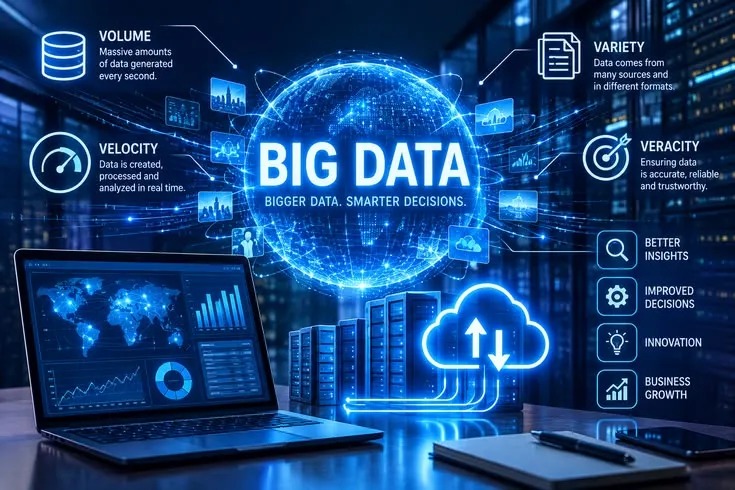
In 2026, big data is no longer primarily about volume. It is about velocity, usability, trust, and the ability to power intelligent systems that act with context and speed. Businesses that align their data strategies with these realities will find themselves better equipped to navigate complexity and capture new opportunities in an increasingly data-driven economy.
Read more – gloryhouseworld.com